

How executives should be thinking about the future of the workplace

Director, Center for Digital Transformation, University of California Irvine
When most people think about artificial intelligence, the focus is usually on the way it is transforming functions like coding, answering questions or automating customer service. But the most important thing to understand is that AI is not just another tool — it’s a foundational technology, like the steam engine, electricity, railroads and digital computers, that will reshape every aspect of our lives.
History offers some clues. Take electricity. At first, its benefits to physical spaces were clear with applications for light, heat and communication. Electric lighting allowed workplaces to function around the clock. With the emergence of factory machinery, many types of work shifted out of the home into commercial spaces. But the true revolution was something few foresaw until later: skyscrapers. Without elevators powered by electricity, no one would climb 100 stories to reach an office. This single technology reshaped cities, commerce and daily life in ways unimaginable at the time.
AI will have the same kind of impact.
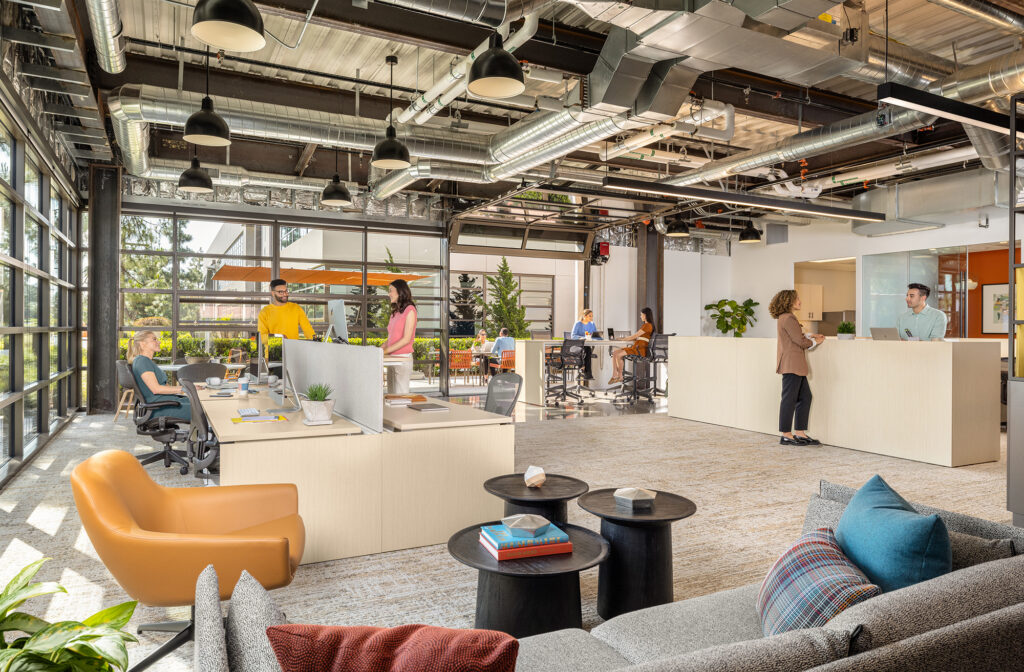 Innovation Office Park, Irvine, CA
As AI technologies advance, innovative businesses and entrepreneurs are conjuring up new ways to exploit its potential. Today, we see hints — self-driving cars on the streets of Los Angeles and San Francisco, humanoid robots folding laundry, generative AI assisting workers in countless everyday tasks, from answering simple queries to supporting research scientists. Yet these developments are just the equivalent of lightbulbs. The skyscraper equivalent is still to come. We’re still learning how humans and thinking machines will work best alongside each other, so the AI-powered workplace of the future is uncertain, but we can be sure it won’t resemble what we know today.
This uncertainty means leaders need to move away from a mindset of incremental improvements and prepare to be at the forefront of what is sure to be a revolutionary change in the nature of work. Innovation will always depend on people coming together, but the spaces they use will need to evolve — becoming adaptive, flexible and dynamically reconfigurable. AI will analyze office patterns and individual preferences to create new types of workspaces. Conference rooms will support immersive collaboration, office layouts will be robot-ready for cleaning and delivery and the workplace will adapt to a radically reshaped workforce and new categories of technology-enabled work.
While there is much we can’t predict, what I do know is this: the transformation will be profound. As future work demands more interaction with machines, people will value the connection and interactions that welldesigned workplaces can offer. The best workplaces will reinforce and catalyze the quintessentially human qualities of human connection and collaboration.
Companies that remain flexible — with their people, spaces and technology — will be best positioned to thrive. AI promises to make organizations more productive, and to deliver wealth, healthcare and education at unprecedented levels. But it also means accepting that the office of the future may serve purposes we can’t yet imagine.
The lesson from history is simple: expect the unexpected.
Vijay Gurbaxani is the Taco Bell Endowed Professor of Technology Management and Director of the Center for Digital Transformation at the UCI Paul Merage School of Business. He is a distinguished scholar and expert on digital transformation, the strategic impact of artificial intelligence (AI) on business and the economics of technology. Gurbaxani has devoted his academic career to advancing the understanding of the digital economy and guiding business leaders through the opportunities and challenges of technological innovation.